National Technology Day, Operation Samudra Setu
May 11, 2020 · Param IAS Team
1. National Technology Day- 11th May
- May 11th on every year as National Technology Day to commemorate achievements of innovations and technological excellence in the country.
- The day has a historical perspective as it was on May 11, 1998, that India achieved a major technological breakthrough by successfully carrying out nuclear tests at Pokhran.
- Further, the first indigenous aircraft "Hansa-3" was test flown at Bangalore on this day and India also performed successful test firing of the Trishul missile on the same day.
- Since 1999, the day is being celebrated as National Technology Day.
- Dr APJ Abdul Kalam lead the Indian team of scientists to successfully test-fire the Shakti-1 nuclear missile at Rajasthan's Pokhran test range.
- The celebration of Technology Day symbolizes India's quest for scientific inquiry, technological creativity & innovations, and the integration of these developments into national socio-economic benefits and global presence.
- A high-level digital conference on 'Rebooting the Economy through Science, Technology and Research Translations titled RESTART' will be organised by Technology Development Board (TDB) a statutory body of the Department of Science & Technology (DST) and Confederation of Indian Industry (CII) on Monday, May 11, 2020, to celebrate the National Technology Day.
- India is currently among eight countries in the world that have a publicly known nuclear weapons programme.
- In 1974, India conducted its first nuclear test, codenamed "Smiling Buddha", at Pokhran in Rajasthan.
2. Operation Samudra Setu - INS Magar (Vande Bharat Mission)
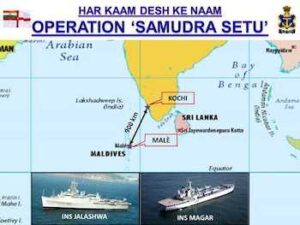
- INS Magar, the second naval ship of the Indian Navy's Op Samudra Setu, to evacuate stranded Indian Nationals from Maldives and ensure smooth and safe passage back to India.
- Indian Navy as part of Operation Samudra Setu under the Vande Bharat Mission has deployed INS Magar for second phase of repatriation of Indian citizens from Maldives.
- In the first phase, INS Jalashwa had evacuated a total of 698 Indian nationals stranded in the Maldives on 10 May 20.
- A total of 202 personnel have embarked the ship, which includes 24 women, two expectant mothers and two children.
- One of the men, who hails from Tamil Nadu, has a fractured leg.
- The evacuation operation was conducted in accordance with all Standard Operating Procedures (SOP) and guidelines issued by the Government of India.
- Government of India started Vande Bharat Mission - one of the largest initiatives to repatriate nationals back to India, on 7th May 2020.
- Under this mission, Ministry of Civil Aviation is coordinating with Ministry of External Affairs and state Governments for bringing Indians back to their homeland.
- INS Jalashwa, based at Visakhapatnam has been at the forefront of similar evacuation efforts of Indian nationals and major Humanitarian Assistance and Disaster Relief (HADR) efforts of the Indian Navy.
3. Sanitise electronic gadgets, papers and currency notes
- The RCI has also developed an automated UVC currency sanitising device, called NOTESCLEAN.
- Bundles of currency notes can be sanitised using DRUVS, however disinfection of each currency notes using it will be a time consuming process.
- For that purpose, a sanitising technique has been developed, where one has to just place the loose currency notes at the input slot of the device.
- It picks the notes one by one and makes them pass through a series of UVC lamps for complete disinfection.
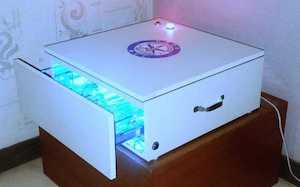
- Hyderabad based Defence Research and Development Organisation (DRDO) premier lab, Research Centre Imarat (RCI), has developed an automated contactless UVC sanitisation cabinet, calledDefence Research Ultraviolet Sanitiser (DRUVS).
- It has been designed to sanitise mobile phones, iPads, laptops, currency notes, cheque leafs, challans, passbooks, paper, envelopes, etc.
- The DRUVS cabinet is having contactless operation which is very important to contain the spread of virus.
- The proximity sensor switches, clubbed with drawer opening and closing mechanism, makes its operation automatic and contactless.
- It provides 360 degree exposure of UVC to the objects placed inside the cabinet.
- Once the sanitisation is done, the system goes in sleep mode hence the operator need not wait or stand near the device.